Raceway Heat Treatment for Slewing Bearings
The raceway is the critical contact surface of slewing bearings. Heat treatment directly determines the load capacity and service life of bearings.
We adopt CNC medium-frequency induction hardening for selective surface hardening of raceways, followed by low-temperature tempering to stabilize the metal microstructure.
- Raceway surface hardness: HRC50~60, with controllable effective hardened depth and uniform hardened band, free of soft zones.
- Hardened surface delivers excellent wear resistance and prevents raceway pitting and spalling under cyclic rolling loads.
- The bearing core retains high toughness to absorb shock loads and avoid ring fracture.
- Tempering removes residual internal stress, ensures dimensional stability and reduces long-term deformation risk.
Heat-treated raceways support stable operation under heavy load, alternating load and harsh field conditions. Our slewing bearings serve wind power, construction machinery, iron roughnecks, shield machines and cranes for reliable long-term performance.
The schematic diagram of the quenching process is shown below:
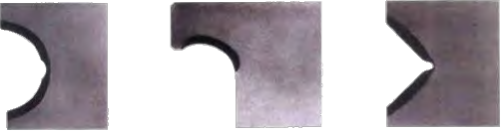
Single row four point contact ball raceway Double row different ball diameter Single row crossed roller raceway
pressure ring raceway
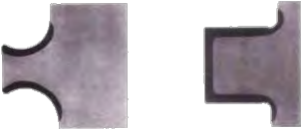
Double row differential ball nose ring raceway Three row roller nose ring raceway
Gear Heat Treatment
For the purpose of transmitting forces or torques, a slewing bearing is typically equipped with teeth on one of its rings. The heat treatment state of these gears is generally normalizing or quenching and tempering. Depending on the specific application, the gears may also undergo full-tooth quenching or single-tooth induction quenching. Single-tooth induction quenching can, in turn, be classified as surface and root quenching, or surface quenching only.

Full teeth quenching Teeth flank and root quenching Teeth flank quenching
1. Full Teeth Quenching
Features
The entire gear tooth (tooth flank, tooth root and tooth core) is fully hardened across the whole tooth cross-section.
Functions & Advantages
High overall strength and excellent shock resistance. Suitable for extreme shock loads and temporary overload conditions. The reinforced tooth root greatly reduces the risk of tooth breakage.
Limitations
Relatively larger quenching deformation. The tooth core becomes more brittle, not ideal for long-term cyclic fatigue loads.
2. Teeth Flank & Teeth Root Quenching (Our Preferred Process)
Features
Selective induction hardening applied to both tooth flank and tooth root fillet areas. The inner tooth substrate retains original high toughness.
Functions & Advantages
- Hardened tooth flank: resists wear and contact pitting
- Hardened tooth root fillet: significantly improves bending fatigue strength to avoid root cracking, the most common gear failure mode
- Tough substrate absorbs impact loads, with controllable heat treatment deformation
Perfect for heavy-duty and alternating load working conditions.
3. Teeth Flank Only Quenching
Features
Only the outer tooth working surface is hardened; the tooth root fillet remains at the base material hardness without hardening treatment.
Functions & Advantages
Improves wear resistance of tooth surface, reduces pitting and abrasion. Low quenching deformation, simple process.
Limitations
No enhancement on tooth root bending strength. Fatigue cracks tend to initiate at tooth root under cyclic bending loads, which may cause tooth fracture. Only recommended for light-load & low-cycle applications.